
Constellations must be refilled.
Large constellations at current scale require on the order of 1,400 replacement satellites per year — before any growth. The cadence is structural, not cyclical.
The Thesis
The market consensus says space grows from roughly $630 billion today toward $1.8 trillion by 2035. We don't underwrite the headline — we underwrite what every version of that future requires: the systems that let anything operate in orbit at all. For definitions of the core terms, see our orbital infrastructure primer.
01The Coming Scale
This is not a projection that depends on optimism. The growth is structurally committed — in replenishment cycles, regulatory mandates, and launch contracts already signed.
3.5×
Growth in annual orbital launches since 2019 (95 → 329)
~9×
Growth in annual satellite deployment since 2019
10–15K
Satellites per year projected through 2030–2035, base case
80K+
Tracked objects on orbit by 2035, base case
Sources: BryceTech Year in Review · Jonathan's Space Report · ABI Research · public launch manifests
Large constellations at current scale require on the order of 1,400 replacement satellites per year — before any growth. The cadence is structural, not cyclical.
International spectrum and orbital-slot rules require constellations to be orbited on fixed timelines. Thousands of satellites are committed by mandate, not by market mood.
New super-heavy launch capacity and multibillion-dollar constellation programs with signed launch contracts push deployment volume well beyond today's record pace.
Every satellite that goes up needs to know where it is, see what's around it, act without waiting for the ground, and be sustained for years. That is the infrastructure problem.
02A Contested Domain
Defense priorities have shifted decisively. Orbital resilience, maneuverability, and control are matters of national capability for the United States and its allies — not research programs.
Navigation, sensing, and command of orbital assets determine what a nation can see, coordinate, and defend. The contest is over control layers, not launch pads.
U.S. and allied programs are committing real, multi-year budgets to orbital resilience and autonomy. Companies embedded in those programs earn revenue, not pilot dollars.
Government missions validate and fund the hard engineering. Commercial markets — logistics, insurance, communications, energy — scale it. We require both.
03Not Launch
Launch costs fell more than 90% in a decade — a historic achievement that created this market. But access is now abundant, competitive, and increasingly commoditized. Launch-only business models without recurring revenue have consistently underperformed.
The durable value sits in what abundance creates: congestion, coordination problems, contested orbits, and fleets too large for human operators. Value accrues to the layers that solve those problems — the systems of control.
Capital flows into infrastructure. Value accrues to intelligence.
04The Four Rails
Four capabilities sit beneath every operational system in orbit. Each is mission-critical, has high switching costs, and compounds as the fleet above it grows.
CAP / 01
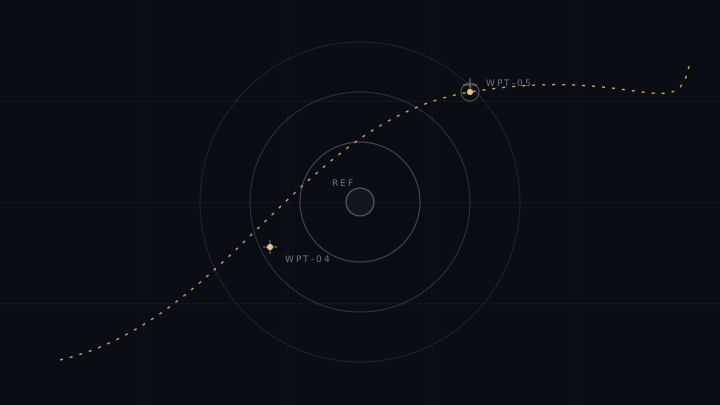
Precision position, navigation, and timing where GPS is degraded, denied, or absent — cislunar space, contested orbits, and the surface of other worlds. Navigation is a system dependency: every layer above it is blind without it.
What we look for: flight-proven systems embedded in funded missions
CAP / 02
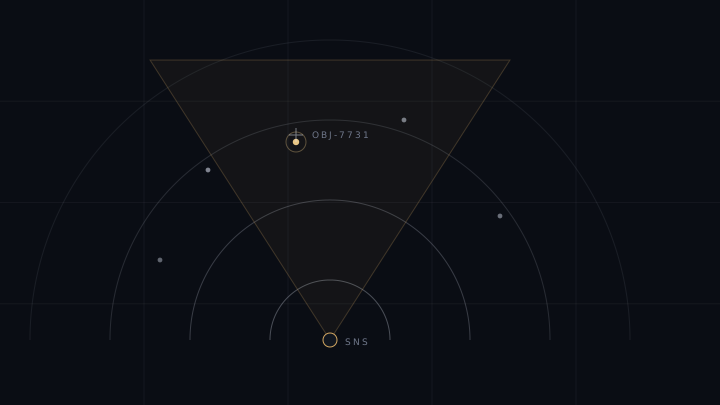
Persistent, machine-speed awareness — of objects in orbit, of activity on Earth, and of threats across both. Sensing converts physical reality into the data layer that institutions, insurers, and commanders act on.
What we look for: proprietary data with recurring institutional demand
CAP / 03
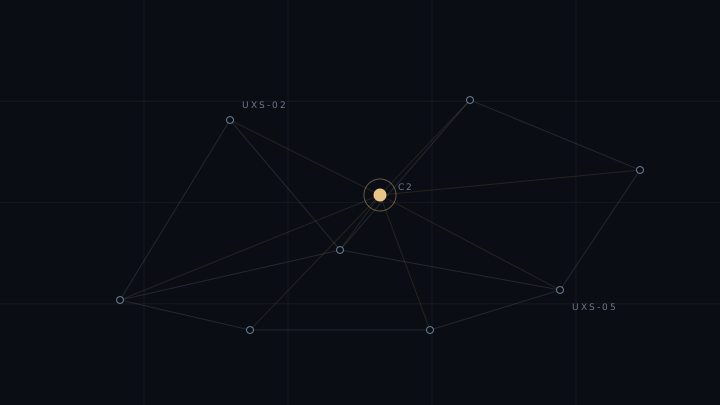
Latency, scale, and mission complexity make constant ground control impossible. Orbital systems must self-route, self-coordinate, and self-defend under human direction. Autonomy is the force multiplier across every other layer.
What we look for: platform economics that scale without proportional cost
CAP / 04
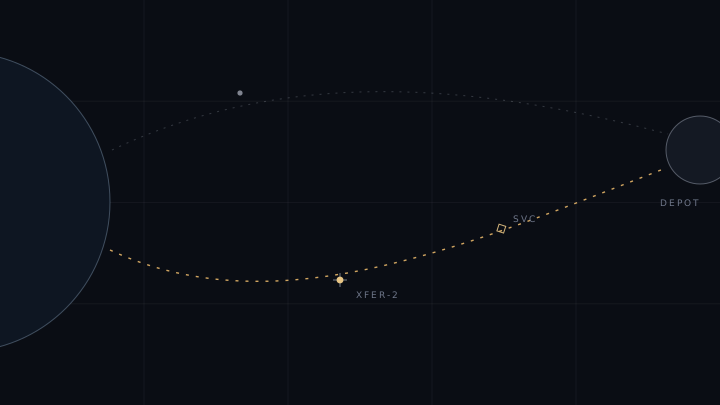
Servicing, deployment, in-space manufacturing, and the industrial and financial supply chains that sustain a permanent presence. The orbital economy runs on logistics the way the terrestrial one does — invisibly, and indispensably.
What we look for: infrastructure positions with government contract anchors
05Discipline
We don't take raw science risk, and we don't wait until a company is obvious. Five characteristics, applied without exception.
Systems proven outside the lab — in flight, in the field, in mission conditions — with a structural lead built on proprietary data, sensors, or simulation.
Founders and boards with prior exits and operating history inside NASA, defense, and frontier-engineering environments.
Navigation, sensing, autonomy, or logistics positions where displacement requires years of requalification — not features that can be copied in a quarter.
Capital and corporate partners able to carry a company through downside cycles and 7–10 year defense and space timelines.
A real commercial path alongside the government mission — lunar navigation, supply-chain finance, industrial autonomy — so no company depends on a single customer.
We source inside the programs and communities where these systems are built, and commit before the broader market recognizes the position.
06How It Resolves
More than $15 billion of strategic space M&A closed between 2023 and 2026. The pattern across every successful exit: contracted recurring revenue or irreplaceable defense relevance.
Defense primes, aerospace leaders, and technology platforms acquire orbital infrastructure for strategic capability — not revenue multiples.
Recurring revenue, contracted customer bases, and picks-and-shovels positions that enable constellations have driven the multibillion-dollar outcomes.
Launch-only models without recurring revenue and constellation operators without a profitability path have consistently underwhelmed. We avoid both.
Continue
The portfolio spans all four capability layers — companies already embedded in the missions that define this market.